
Research
My research develops optimization methods for large-scale, structured, and stochastic decision problems, with a focus on sustainable transportation. The goal is to build algorithms that are innovative, rigorously grounded, and practically useful.
Application Domains
Public Transit & Metro Systems
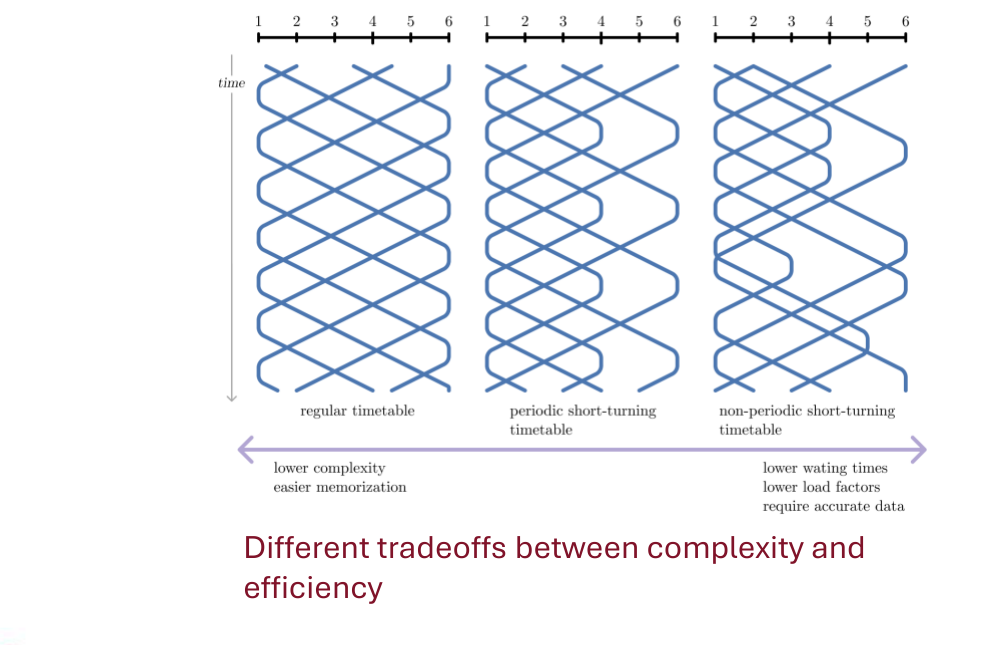
How to schedule trains to match fluctuating passenger demand, when to deploy short-turning strategies to absorb disruptions, how to integrate multiple modes (rail, bus, micromobility) into a coherent network. My work addresses these problems through demand-driven optimization frameworks that adapt schedules dynamically rather than relying on fixed timetables. Currently I am expanding on this area to focus on Network Design and multimodal transportation.
Key themes:
- Demand-driven timetabling and frequency setting
- Short-turning and adaptive metro operations
- Multimodal and express transit planning
Electric Vehicle Infrastructure
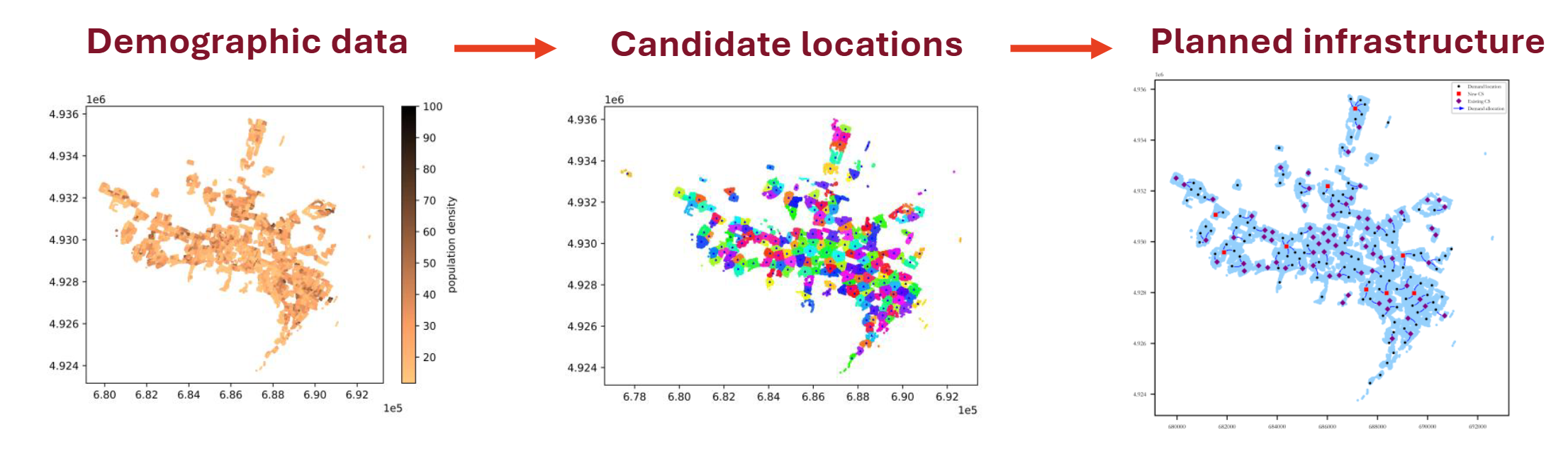
The transition to electric mobility requires coordinated decisions about where to locate charging stations, how to size them, and how to plan their deployment over multi-year horizons. A related challenge is integrating EV fleets into ride-hailing and shared mobility systems. My research addresses these problems as structured stochastic optimization models with realistic operational constraints.
Key themes:
- Location and capacity planning for charging infrastructure
- Multi-period investment under demand uncertainty
- EV integration in ride-hailing and shared fleets
These two domains serve as primary case studies. The methods are designed to generalize: the underlying algorithms apply to logistics, energy systems, and infrastructure planning more broadly.
Methodological Approaches
Decomposition Algorithms
Many large-scale optimization problems in transportation and infrastructure have a block-angular or stochastic structure that can be exploited algorithmically. I specialize in Benders decomposition and related exact-hybrid methods that break a hard problem into a master problem and subproblems, enabling solutions at scales that monolithic solvers cannot reach. A significant part of my work focuses on strengthening these methods to make them practical on real instances.
Discrete Simulation-Based Optimization (DSO)
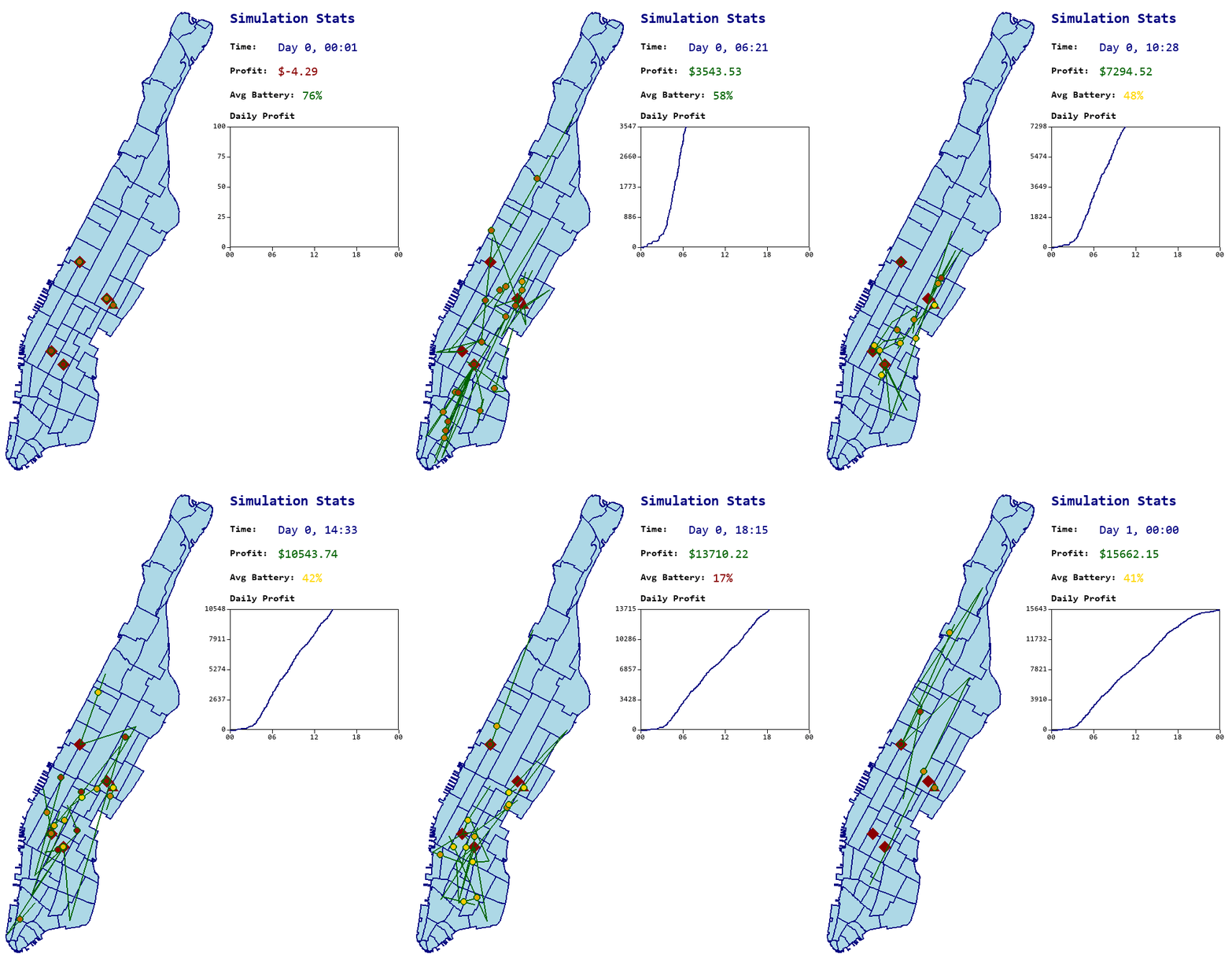
Some problems are too complex for closed-form models: stochastic dynamics, heterogeneous agents, non-linear interactions. Discrete simulation-based optimization couples a high-fidelity discrete-event simulation with an optimization layer that iteratively searches for better decisions based on simulated outcomes. My postdoctoral work at HEC Montréal / GERAD developed DSO frameworks for stochastic combinatorial problems, with applications in ride-hailing fleet management and EV charging operations.
A central challenge in DSO is computational cost: high-fidelity simulations are expensive, and naively running thousands of them to explore the solution space is impractical. My work addresses this by integrating machine learning directly into the search process. Learned surrogate models approximate the simulation objective from past evaluations, guiding the optimizer toward promising regions of the solution space without requiring a full simulation at every step.
Heuristics and Metaheuristics
Exact methods are not always tractable. I have extensive experience designing problem-specific heuristics and metaheuristics that find high-quality solutions efficiently on hard combinatorial problems.
Collaboration & Funding
This research program is supported by an NSERC Discovery Grant (2025–2030). I am open to collaboration with industry partners in transit agencies, EV operators, and logistics.